

Cryptocurrency has become a hot topic in U.S. politics, and Donald Trump’s stance has sparked curiosity. Once a critic, Trump now calls himself the “crypto president.” His actions in his second term, starting January 2025, have stirred both support and skepticism. This article explores Trump’s shift, his administration’s policies, their effect on crypto, and the controversies involved. We’ll also answer questions like “What is Trump’s crypto policy?” and “Is his support genuine?”
Why Trump’s Crypto Stance Matters
Trump’s position on crypto could shape the industry’s future. His policies may create opportunities for investors but also bring risks. Understanding his approach helps you make informed decisions in the fast-changing crypto world.
Trump’s Shift from Critic to Supporter
Trump wasn’t always pro-crypto. In 2018, he called Bitcoin “based on thin air.” In 2021, he told Fox Business it was a “scam.” But during his 2024 campaign, he changed his tune. He promised to make the U.S. the “crypto capital of the world.” By July 2024, he spoke at a Bitcoin conference in Nashville, outlining a vision for U.S. crypto leadership.
What caused this shift?
- Campaign Funds: The crypto industry donated over $238 million to the 2024 election, including $18 million to Trump’s inauguration.
- Voter Appeal: Crypto appealed to young, tech-savvy voters.
- Industry Ties: Supporters like Elon Musk and Howard Lutnick, with crypto interests, backed Trump.
This change set the stage for major policy moves in 2025.
Key Actions by Trump’s Administration
Since January 2025, Trump’s administration has taken steps to support crypto. Here’s what they’ve done:
1. Executive Order on Digital Assets (January 2025)
Trump signed an order on January 23, 2025, to boost U.S. crypto leadership. It:
- Created a President’s Working Group on Digital Asset Markets.
- Limited central bank digital currencies (CBDCs).
- Supported stablecoins and crypto firms’ banking access.
2. Strategic Bitcoin Reserve (March 2025)
On March 6, 2025, Trump launched the Strategic Bitcoin Reserve. It treats Bitcoin as a reserve asset, using forfeited Treasury Bitcoin. No sales are allowed, aiming to make the U.S. a crypto leader.
3. GENIUS Act (July 2025)
On July 18, 2025, Trump signed the Guiding and Establishing National Innovation for U.S. Stablecoins Act (GENIUS Act). It:
- Sets rules for stablecoins, cryptocurrencies tied to assets like the dollar.
- Passed with bipartisan support (308-122 in the House).
- Aims to make crypto a common payment method.
4. Reduced Oversight (April 2025)
In April 2025, Trump disbanded the Justice Department’s crypto enforcement unit, created in 2022 to tackle crypto crimes. This move signals less regulation but raises concerns about fraud.
5. Crypto-Friendly Appointments
Trump appointed:
- Paul Atkins as SEC chair, a crypto advocate.
- Scott Bessent as Treasury Secretary, a blockchain supporter.
6. White House Crypto Summit
On March 7, 2025, Trump hosted the first White House Crypto Summit. He also formed an SEC Crypto Task Force in February 2025, which dropped lawsuits against firms like Coinbase and Ripple.
These actions show Trump’s commitment to crypto, but they’ve sparked debate.
Trump’s Crypto Investments
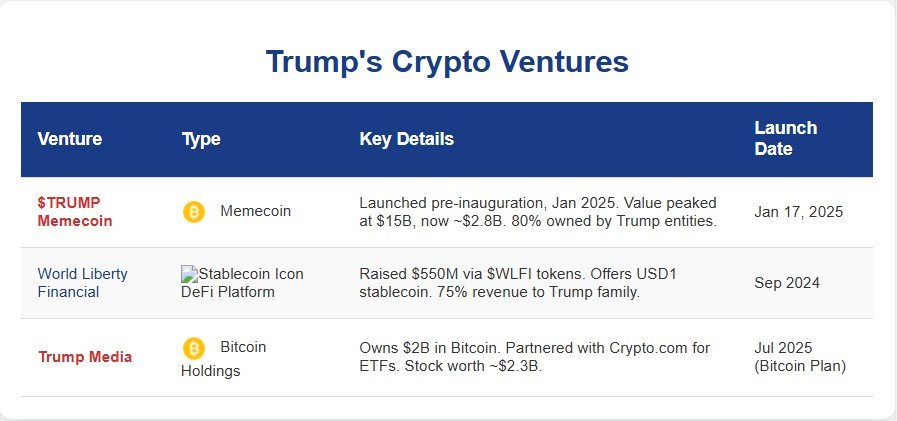
Trump and his family have deep financial ties to crypto, raising concerns about conflicts of interest. Their ventures include:
| Venture | Details | Estimated Earnings |
|---|---|---|
| $Trump Memecoin | Launched January 17, 2025, as the “only official Trump meme.” Reached $2.4 billion in circulation by May 2025. | Trump Organization holds 80%, earning $349 million by April 2025. |
| World Liberty Financial | Run by Trump’s sons, launched the USD1 stablecoin. Secured a $2 billion Binance deal. | Trump owns 60%, earned $57 million in 2024. |
| Trump Media & Technology Group | Majority-owned by Trump, plans to raise $2.5 billion for a Bitcoin stockpile. Filed for crypto ETFs in 2025. | Holds $2 billion in Bitcoin by July 2025. |
Critics, like Senator Elizabeth Warren, argue these ventures show Trump’s policies may benefit himself over the public.
How Trump’s Policies Affect Crypto
Trump’s actions have reshaped the crypto industry, with both benefits and risks.
Benefits
- Clearer Rules: The GENIUS Act offers a framework, encouraging investment. The stablecoin market could hit $2 trillion by 2028.
- Market Surge: Bitcoin reached $123,000 in July 2025, driven by Trump’s policies. Ripple (XRP) and Solana (SOL) also rose.
- Mainstream Use: Trump’s support may push banks and businesses to adopt crypto.
Risks
- Conflicts of Interest: Trump’s ventures could influence policies, raising ethical concerns.
- Volatility: The $Trump memecoin’s rise and fall shows market risks.
- Less Oversight: Reduced regulation could lead to fraud and money laundering.
Is Trump’s Support Genuine?
Some question if Trump’s support is driven by politics or personal gain. The crypto industry’s $238 million in election donations suggests political motives. His financial stakes also raise doubts. However, actions like the GENIUS Act and Bitcoin Reserve show commitment to crypto growth.
Trump vs. Other Politicians
Trump’s stance differs from others:
- Kamala Harris: Focused on consumer protection and stricter rules during the 2024 campaign.
- Elizabeth Warren: Warns about crypto risks, criticizing Trump’s deregulation.
- Libertarian Republicans: Like Tom Emmer, they see crypto as a tool for financial freedom, aligning with Trump.
Trump’s aggressive deregulation sets him apart.
What This Means for You
Trump’s policies could make crypto more accessible but riskier. Investors should:
- Stay updated on regulations.
- Research crypto projects carefully.
- Be cautious of volatile assets like memecoins.
Visit Krypdrops.com for more crypto insights, like How to Start Investing in Cryptocurrency or What is a Crypto ETF?.
Conclusion
Trump has gone from calling Bitcoin a “scam” to championing crypto as president. His 2025 policies, like the GENIUS Act and Bitcoin Reserve, aim to make the U.S. a crypto leader. But his financial ties raise concerns about conflicts of interest. For investors, this creates opportunities and risks. Stay informed to navigate this changing landscape.
FAQs
1. What is Trump’s crypto policy?
Trump promotes crypto through deregulation, the GENIUS Act, and a Strategic Bitcoin Reserve.
2. Why did Trump change his stance on crypto?
Campaign donations, voter appeal, and industry ties drove his shift from critic to supporter.
3. How do Trump’s policies affect crypto investors?
They could boost adoption and prices but increase volatility and fraud risks.
4. Is Trump’s crypto support genuine?
It may be driven by politics and personal gain, but his actions show commitment.
5. How does Trump’s stance compare to others?
Trump pushes deregulation, unlike Democrats who focus on consumer protection.

