


Cryptocurrencies like Bitcoin and Ethereum have reshaped finance, but a key question persists: Is crypto a security? This issue affects how cryptocurrencies are regulated, traded, and used. The answer isn’t straightforward—it depends on the crypto, its creation, and its use.
This guide explains whether cryptocurrencies are securities. We’ll cover legal definitions, recent cases, and what this means for investors and businesses. By the end, you’ll understand this complex topic and its impact on the crypto world.
What Is a Security?
A security is a financial instrument, like stocks or bonds, regulated by the U.S. Securities and Exchange Commission (SEC). Securities represent ownership in a company or debt owed by an entity.
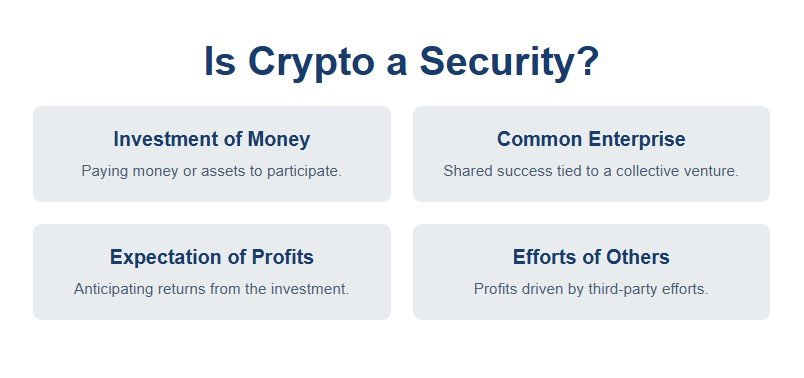
The Howey Test, set by the Supreme Court in 1946, determines if something is a security. It has four parts:
- You invest money or assets.
- The investment is in a shared venture.
- You expect profits from it.
- Profits come from the efforts of others.
If a cryptocurrency meets these criteria, it’s likely a security and must follow SEC rules, like registration and disclosures.
How Does the SEC View Cryptocurrencies?
The SEC often classifies cryptocurrencies as securities if they meet the Howey Test. They’ve taken legal action to enforce this view.
In 2020, the SEC sued Ripple Labs, claiming XRP was a security in institutional sales. In 2023, a judge ruled that XRP sold on public exchanges wasn’t a security, but direct sales to institutions, worth $1.3 billion from 2013 to 2020, violated securities laws.
In 2023, the SEC also sued Coinbase, arguing it operated as an unregistered securities exchange. They claimed cryptos like Solana and Cardano were securities. These cases highlight the SEC’s push to regulate crypto under securities laws.
For more on platform safety, see Is Crypto.com Safe?.
Why Some Argue Crypto Isn’t a Security
Not everyone agrees with the SEC. A 2022 Harvard Law School paper, “Why Cryptoassets Are Not Securities,” argues that fungible cryptoassets, like those traded on exchanges, don’t meet the Howey Test.
The paper criticizes the SEC’s idea that a cryptoasset stops being a security when its network becomes “sufficiently decentralized.” It calls this impractical and suggests separating initial coin offerings (ICOs) from the cryptoassets themselves. ICOs may be securities, but tokens traded later, like Bitcoin or Ether, often aren’t.
This view pushes for clearer rules to avoid stifling innovation. Read more at Harvard Law School: Why Cryptoassets Are Not Securities.
Is Bitcoin a Security?
Bitcoin is not considered a security. It wasn’t created through an ICO, has no pre-mined coins, and operates on a decentralized network. Its value doesn’t rely on a single company, so it fails the Howey Test’s “common enterprise” and “efforts of others” criteria.
In 2018, former SEC Director William Hinman confirmed Bitcoin isn’t a security. It’s often treated as a commodity, regulated by the Commodity Futures Trading Commission (CFTC).
What About Ether and Other Cryptocurrencies?
Ether’s status is less clear. Ethereum’s 2014 ICO, which raised funds by selling 60 million ether tokens, likely met the Howey Test as a security. But once Ether started trading on secondary markets, its classification became debated.
In 2018, Hinman suggested Ether isn’t a security due to Ethereum’s decentralization. The 2022 shift to proof-of-stake made it even more decentralized, supporting this view. However, the SEC hasn’t officially confirmed this.
Ripple’s XRP faced a split ruling in 2023. Public exchange sales were not securities, but institutional sales were. Context matters for each crypto.
Learn more about Ripple in What is XRP Guide.
Security Tokens vs. Cryptocurrencies
Security tokens are different from cryptocurrencies. They represent ownership in a company or asset, like real estate or stocks, and are designed as securities. For example, the bNVDA token on the INX exchange represents Nvidia stock and follows SEC rules.
Cryptocurrencies like Bitcoin or Ether aim to function as currencies or commodities, not securities. This distinction affects how they’re regulated and traded.
The Regulatory Landscape in 2025
The SEC regulates securities, while the CFTC oversees commodities. Bitcoin is a commodity, but others, like Ether or XRP, fall into a gray area.
U.S. lawmakers are working on clarity. The Responsible Financial Innovation Act (RFIA), proposed by Senators Lummis and Gillibrand, seeks to define crypto rules. House Financial Services Committee Chair Patrick McHenry pushed for crypto legislation by mid-2023, though progress continues into 2025.
The EU’s Markets in Crypto-Assets (MiCA) regulation, passed in 2023, provides a clear framework for all cryptoassets. It’s a potential model for the U.S.
For crypto market trends, read Will Crypto Recover?.
What This Means for Investors and Businesses
If a crypto is a security, it must follow SEC rules, like registering and providing financial details. This offers investors protections, like fraud prevention, but adds restrictions, like limits on who can invest.
For businesses, securities laws mean complex compliance. Crypto exchanges or token issuers may need to register with the SEC, hire legal teams, and ensure anti-fraud measures. Non-compliance risks lawsuits, as seen with Ripple and Coinbase.
For safe crypto buying, check How to Buy Crypto Without KYC.
What’s Next for Crypto Regulation?
The debate over crypto as securities continues. A July 2025 post from CoinDesk quoted SEC head Paul Atkins saying most cryptoassets aren’t securities, signaling a potential shift. However, this view isn’t final, and the SEC’s stance remains strict.
New U.S. laws or clearer SEC guidelines could resolve this. The EU’s MiCA shows how comprehensive rules can work. For now, investors and businesses should stay informed and comply with existing laws.
Key Takeaways
- Bitcoin: Not a security due to its decentralized nature.
- Ether and XRP: Status depends on context; ICOs may be securities, but secondary trading often isn’t.
- SEC’s Role: Actively regulates cryptos as securities if they meet the Howey Test.
- CFTC’s Role: Oversees commodities like Bitcoin.
- Future Rules: U.S. laws like the RFIA and EU’s MiCA aim to clarify crypto regulation.
Stay updated, understand risks, and ensure compliance to navigate this evolving landscape.
FAQs
- Is Bitcoin a security? No, it’s decentralized and not an ICO product.
- Is Ethereum a security? Its ICO was likely a security; secondary trading is debated.
- What is the Howey Test? A 1946 test with four criteria to define securities.
- How does the SEC regulate crypto? Treats many cryptos as securities, requiring registration.
- What’s the difference between a security and a commodity? Securities (SEC) involve investments; commodities (CFTC) are assets like Bitcoin.
- Are all cryptos securities? No, it depends on the crypto’s structure.
- What makes a crypto a security? Meeting the Howey Test criteria.
- Can crypto be both a security and a commodity? Possible, but classifications differ.
- What is tokenization? Turning assets into digital tokens, often securities.
- What is the EU’s MiCA regulation? A 2023 law for clear crypto rules.

