

Liquidity is a critical concept in cryptocurrency that affects how easily you can buy or sell digital assets without causing significant price changes. Whether you’re a trader, investor, or simply curious about crypto, understanding liquidity is essential for navigating the market effectively. In this guide, we’ll break down what liquidity means in crypto, why it matters, and how it impacts trading and market health. We’ll also explore related concepts like liquidity pools and provide actionable tips for trading in liquid markets.
What is Liquidity in Crypto?
Liquidity refers to the ease with which an asset—whether it’s a cryptocurrency like Bitcoin or an altcoin—can be bought or sold without significantly affecting its price. In simple terms, a highly liquid asset has many buyers and sellers, making it easy to trade without causing large price swings. An illiquid asset has fewer participants, so even small trades can lead to big price movements.
For example, Bitcoin is one of the most liquid cryptocurrencies because it has a large number of active traders and high trading volumes. This means you can buy or sell Bitcoin quickly without drastically impacting its price. In contrast, a lesser-known altcoin might be illiquid, making it harder to find buyers or sellers and more prone to price volatility.

Why is Liquidity Important in Crypto?
Liquidity is crucial for several reasons:
- Price Stability: High liquidity helps keep prices stable. With many buyers and sellers, large trades don’t cause significant price fluctuations.
- Trading Efficiency: Liquid markets allow for quick and smooth transactions, which is especially important in fast-moving crypto markets.
- Market Health: A liquid market is generally healthier and more attractive to investors, as it indicates a robust ecosystem with active participation.
- Reduced Risk: For traders, liquidity lowers the risk of getting stuck with an asset they can’t easily sell.
Low liquidity, on the other hand, can lead to:
- Higher Volatility: Small trades can cause large price swings.
- Slippage: The difference between the expected price of a trade and the actual price at which it’s executed.
- Difficulty Exiting Positions: If you can’t find enough buyers, you might struggle to sell your holdings.
How Does Liquidity Work in Cryptocurrency?
Liquidity in crypto markets is facilitated through exchanges, which can be centralized (CEXs) or decentralized (DEXs).
- Centralized Exchanges (CEXs): These platforms, like Binance or Coinbase, use order books where buyers and sellers place their orders. A deep order book with many buy and sell orders indicates high liquidity. Learn more about trading on CEXs.
- Decentralized Exchanges (DEXs): DEXs, such as Uniswap, rely on automated market makers (AMMs) and liquidity pools. These pools are created by users who deposit their tokens into smart contracts, providing the liquidity needed for trading.
Factors That Influence Liquidity in Crypto
Several factors can affect the liquidity of a cryptocurrency:
- Trading Volume: Higher trading volume generally means higher liquidity, as there are more active buyers and sellers.
- Number of Market Participants: A larger number of traders increases the likelihood of finding counterparties for trades.
- Regulatory Environment: Regulations can impact the availability of exchanges and the willingness of participants to trade.
- Technological Advancements: Improvements in blockchain technology and exchange platforms can make trading more efficient, boosting liquidity.
| Factor | Impact on Liquidity |
|---|---|
| Trading Volume | Higher volume increases liquidity by providing more buy and sell opportunities. |
| Number of Participants | More traders mean more liquidity, as there are more potential counterparties. |
| Regulatory Environment | Strict regulations may reduce liquidity by limiting exchange access or participation. |
| Technological Advancements | Better technology can enhance trading efficiency, increasing liquidity. |
Liquidity Pools in DeFi
In decentralized finance (DeFi), liquidity pools are a key mechanism for providing liquidity. These pools are smart contracts that hold reserves of different tokens, allowing users to trade one token for another directly.
- How They Work: Users deposit tokens into the pool, becoming liquidity providers. When someone wants to trade, they swap tokens from the pool, and the pool’s composition adjusts based on the trade.
- Benefits for Liquidity Providers: Providers earn a portion of the trading fees generated by the pool.
- Risks: Liquidity providers are exposed to impermanent loss, which occurs when the price of the tokens in the pool changes significantly relative to each other. There’s also the risk of smart contract vulnerabilities.
Liquidity pools are essential for DEXs, as they enable trading without the need for traditional order books. Learn more about DeFi and crypto trading.
How to Measure Liquidity in Crypto
Liquidity can be measured using several metrics:
- Trading Volume: The total amount of a cryptocurrency traded over a specific period. Higher volume often indicates higher liquidity.
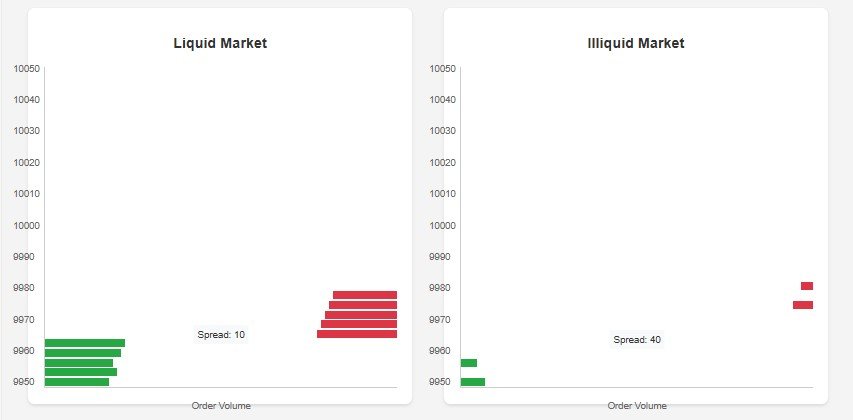
- Market Depth: The number and size of buy and sell orders in the order book at different price levels. A deep order book means there are many orders available, indicating high liquidity.
- Bid-Ask Spread: The difference between the highest price a buyer is willing to pay (bid) and the lowest price a seller is willing to accept (ask). A smaller spread typically indicates higher liquidity.
Tools like CoinMarketCap and CoinGecko provide data on these metrics, helping traders assess liquidity.
| Metric | Description |
|---|---|
| Trading Volume | Total amount of a cryptocurrency traded over a period, indicating market activity. |
| Market Depth | Size and number of buy/sell orders in the order book, showing liquidity depth. |
| Bid-Ask Spread | Difference between highest buy and lowest sell prices, smaller spread = higher liquidity. |
Why Liquidity Matters for Crypto Markets
Liquidity is a cornerstone of healthy crypto markets:
- Price Stability: High liquidity helps prevent extreme price fluctuations, making the market more predictable.
- Trading Strategies: Traders can execute their strategies more effectively in liquid markets, as they can enter and exit positions without significant price impact.
- Market Growth: As liquidity increases, more investors are attracted to the market, leading to further growth and adoption.
Low liquidity can make trading challenging, especially for large orders, and can deter institutional investors who require stable and efficient markets.
Tips for Trading in Liquid Markets
When trading cryptocurrencies, consider the following:
- Choose Liquid Assets: Focus on cryptocurrencies with high trading volumes and deep order books, such as Bitcoin or Ethereum, to minimize slippage. Check out how to convert crypto to cash.
- Understand Slippage: Be aware that in illiquid markets, the price can move significantly between placing an order and executing it. Learn more about slippage.
- Use Limit Orders: These allow you to specify the price at which you want to buy or sell, helping you avoid unfavorable prices due to slippage.
- Monitor Market Depth: Check the order book to see how many buy and sell orders are available at different price levels.
People Also Ask
Here are answers to common questions about liquidity in crypto:
What is the difference between liquidity and volatility in crypto?
Liquidity refers to how easily an asset can be traded without affecting its price, while volatility measures the price fluctuations of an asset over time. High liquidity often leads to lower volatility, but not always.
How do liquidity pools work in DeFi?
Liquidity pools are smart contracts where users deposit tokens to provide liquidity for trading pairs on DEXs. Traders can then swap tokens directly from these pools, and liquidity providers earn a share of the trading fees.
What are the risks of providing liquidity in crypto?
Risks include impermanent loss, where the value of the tokens in the pool changes relative to each other, potentially resulting in a loss compared to holding the tokens separately. There’s also the risk of smart contract vulnerabilities.
How does low liquidity affect crypto prices?
Low liquidity can lead to higher price volatility because even small trades can cause significant price movements. This makes it harder to predict prices and can lead to larger spreads between buy and sell orders.
What are some highly liquid cryptocurrencies?
Bitcoin (BTC) and Ethereum (ETH) are among the most liquid cryptocurrencies due to their high trading volumes and widespread adoption. Other major cryptocurrencies like Binance Coin (BNB), Cardano (ADA), and Ripple (XRP) also have relatively high liquidity.
Conclusion
Liquidity is the lifeblood of cryptocurrency markets. It ensures that trades can be executed smoothly, prices remain stable, and the market remains healthy. Whether you’re a seasoned trader or a newcomer to crypto, understanding liquidity is key to making informed decisions. By focusing on liquid assets, understanding market depth, and being aware of the risks and rewards of liquidity provision, you can navigate the crypto market with greater confidence.
Check the liquidity of your favorite cryptocurrencies on platforms like CoinMarketCap or explore DeFi opportunities to become a liquidity provider. Stay informed, trade smart, and make the most of the crypto market!

